
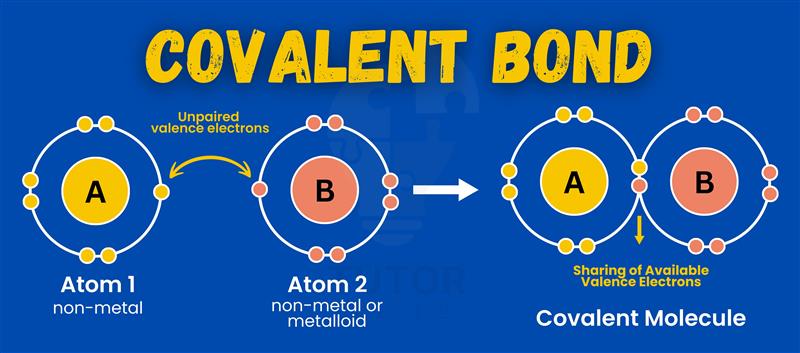
A covalent bond happens when two non-metal atoms share a pair of electrons.
Atoms do this to get a full outer shell, which makes them stable. The bond is held together by a strong pull between the positive centre of the atoms and the shared negative electrons.
Example,
In a water molecule (H₂O), oxygen shares electrons with two hydrogen atoms.
Types of Covalent Bonds (By Electron Pairs)
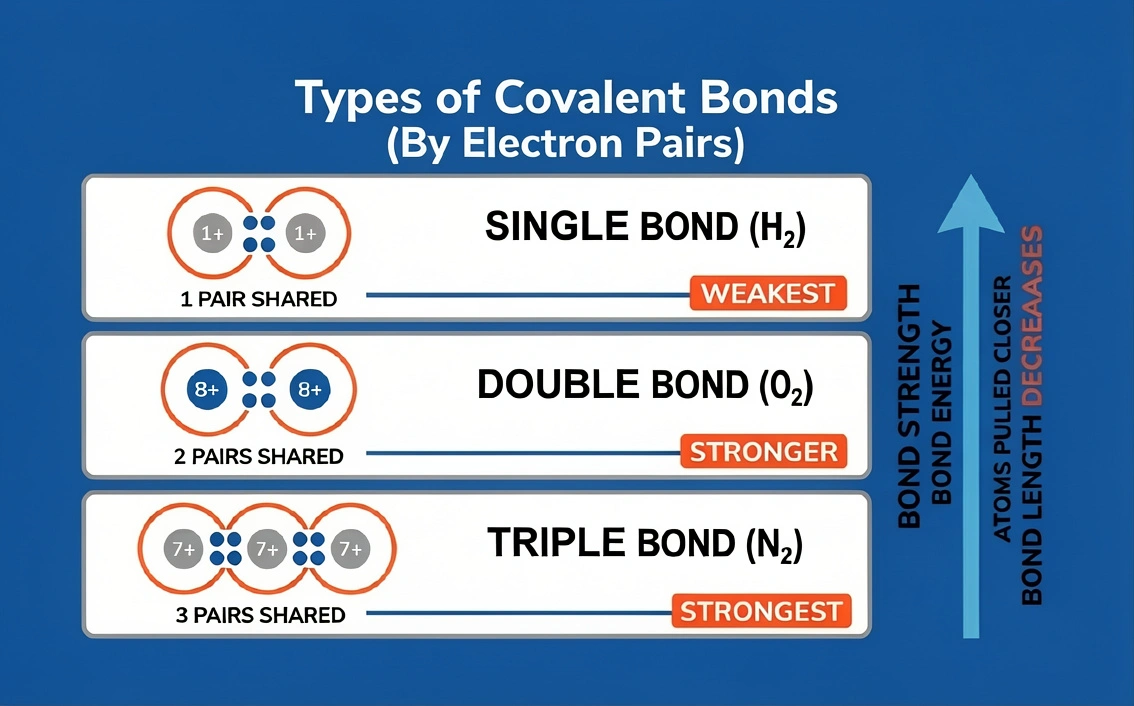
Covalent bonds are classified by the number of shared electron pairs. As the number of shared pairs increases, the bond becomes stronger and the atoms are pulled closer together.
- Single Covalent Bond: Atoms share one pair of electrons. This is the most common type and is represented by a single line (e.g., H—H in Hydrogen gas).
- Double Covalent Bond: Atoms share two pairs of electrons. This requires more energy to break and is represented by a double line (e.g., O=O in Oxygen gas).
- Triple Covalent Bond: Atoms share three pairs of electrons. This is an incredibly strong bond, represented by three lines (e.g., N≡N in Nitrogen gas).
Polarity: Equal vs. Unequal Sharing
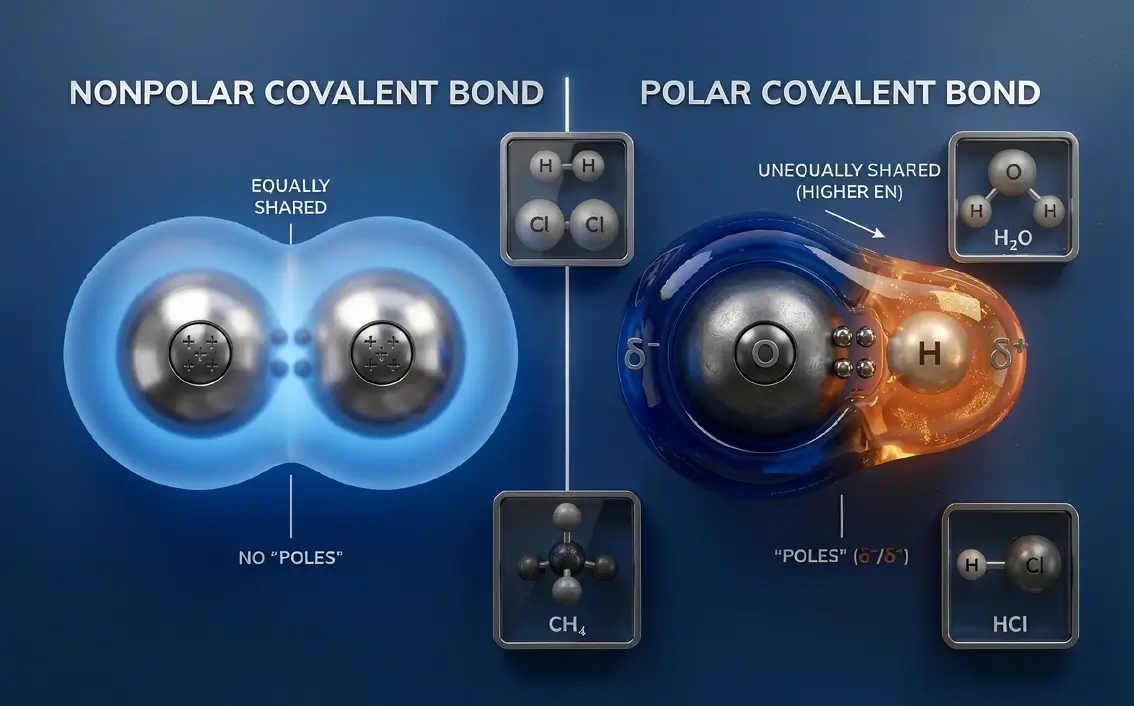
Not all covalent bonds share electrons equally. The “pull” an atom has on electrons is called electronegativity.
Nonpolar Covalent Bonds
When two atoms of the same element (or elements with very similar electronegativity) bond, they share electrons equally.
Because the charge is distributed evenly, there is no “pole” on the molecule.
- Examples: H2, Cl2, and CH4 (Methane).
Polar Covalent Bonds
When one atom is more electronegative than the other, it pulls the shared electrons closer to itself.
This creates a partial negative charge () on the stronger atom and a partial positive charge () on the weaker one.
- Examples: (Water) and (Hydrogen Chloride).
Simple vs. Giant Covalent Structures
To understand the properties of a substance, you must look at how the molecules are organised.
Simple Molecular Structures
These consist of small, isolated molecules like Carbon Dioxide or Water.
- The Bonds: The covalent bonds inside the molecule are very strong.
- The Forces: The forces between the molecules (intermolecular forces) are very weak.
- Result: These substances usually have low melting and boiling points and are often gases or liquids at room temperature.
Giant Covalent Structures (Macromolecules)
In these structures, every atom is joined to several others by strong covalent bonds in a massive lattice.
- Diamond: Each carbon atom forms four bonds, creating an extremely hard structure with a very high melting point.
- Graphite: Each carbon forms three bonds in layers. Because there are delocalised electrons between layers, graphite can conduct electricity.
- Silicon Dioxide: The main component of sand, forming a rigid, heat-resistant structure.
Physical Properties of Covalent Compounds
- Low Melting Points: For simple molecules, very little energy is needed to overcome weak intermolecular forces.
- Electrical Insulators: Most covalent compounds do not conduct electricity because they do not have free ions or delocalised electrons (Graphite is the exception).
- Variable Solubility: Polar covalent substances often dissolve in water, while nonpolar substances usually do not.
- Strength: While the substances might be easy to melt, the actual covalent bonds are among the strongest forces in the universe.
Don’t Make These Mistakes!
- The “Weak Bond” Myth: Many students think covalent bonds are weak because water boils at a low temperature.
Correction: The covalent bond inside the water molecule is never broken during boiling; only the weak intermolecular forces between molecules are overcome. - Conductivity: Don’t assume all “Carbon” structures are insulators. Always remember that Graphite conducts electricity because of its unique three-bond structure and free electrons.
Why Choose Tutorhelpme Chemistry Tutors
- Expert Guidance: Chemistry tutors with deep knowledge of chemistry concepts and applications.
- Simplified Explanations: Learn difficult topics in an easy-to-understand way.
- Personalised Support: Tailored lessons to match your learning pace and goals.
- Proven Results: Boost grades and understanding with effective teaching strategies.
- Affordable Rates: Quality tutoring at competitive prices, starts from £15.
- Exam Preparation: Comprehensive support for GCSE, A-Level, and university exams.
- Flexible Learning Options: Online sessions for convenience and accessibility.
- Interactive Approach: Engaging lessons with practical examples and problem-solving.
- Trusted Service: Positive reviews from satisfied students and parents.
Read More Difference between Ionic Bond and Covalent Bond
FAQs
Which elements form covalent bonds?
Non-metals form covalent bonds with each other by sharing pairs of electrons to achieve stable outer shells.
Does covalent bonding conduct electricity?
No, because the molecules do not have free-moving ions or delocalised electrons to carry an electrical charge.
Why do covalent compounds have low melting points?
Covalent compounds have low melting points because the intermolecular forces between the molecules are weak, requiring very little thermal energy to overcome.
How many electrons are shared in a double bond?
A double covalent bond involves the sharing of four electrons (two pairs) between two atoms. An example is the bond found in an Oxygen () molecule.